Showing posts with label God. Show all posts

Tuesday, February 24, 2026

Remembering the Hereafter: A Protection Against the Corruption of the Heart


Reflections on Surah Ṣād (38:46–49)

In a world dominated by immediacy, the pursuit of pleasure, and the loss of deeper meaning, the question of life after death is often pushed aside. Yet Islamic spirituality teaches that constant remembrance of the Hereafter is one of the most powerful ways to protect a person from moral decline.

The Qur’an highlights this truth through the example of some of the greatest prophets in Surah Ṣād.

A Distinction Granted to the Chosen

Allah mentions Abraham, Isaac, and Jacob — peace be upon them — and reveals the true reason for their excellence:

“Indeed, We chose them for an exclusive quality: remembrance of the Home (of the Hereafter).”
(Surah Ṣād, 38:46)

This divine statement shows that true nobility does not lie in wealth, power, or even knowledge, but in a living awareness of the life to come.

The following verse confirms their elevated status:

“And indeed, in Our sight they are among the chosen, the best.”
(38:47)

Their superiority, therefore, comes from an inner state — a constant clarity about the temporary nature of this world and the reality of eternity.

A Model Extended to Other Righteous Servants

The passage continues by mentioning other virtuous figures:

“And remember Ishmael, Elisha, and Dhul-Kifl — all are among the outstanding.”
(38:48)

Then comes a universal message:

“This is a reminder. And indeed, for the righteous is a good place of return.”
(38:49)

These verses show that awareness of the Hereafter is not reserved for prophets alone; it is the path for anyone seeking righteousness.

Why Does Remembering the Hereafter Protect from Sin?

Keeping in mind that every action has eternal consequences profoundly transforms how a person lives.

It restrains passions

A person is no longer controlled by immediate desires.

It prevents excess

Moderation becomes natural when one anticipates accountability.

It combats corruption

Injustice, deceit, and abuse lose their appeal when one remembers standing before God.

It refines moral judgment

The believer learns to distinguish lasting good from destructive pleasure.

By contrast, forgetting the Hereafter opens the door to every form of deviation. When people believe this life is all there is, injustice can easily be justified in the name of profit or pleasure.

An Invisible but Decisive Quality

Verse 46 speaks of a “special quality.” This refers to an inner state that cannot be measured outwardly but transforms intentions and actions at their root.

Two people may perform the same deeds, yet the one who acts while remembering their meeting with their Lord possesses a sincerity and depth beyond comparison.

Conclusion: Living This Life in the Light of Eternity

Surah Ṣād teaches that true human distinction arises from an awakened awareness of the life to come. Remembering the Hereafter is not an escape from the world — it is the key to living in it with wisdom, justice, and restraint.

The one who keeps the eternal Home in mind does not withdraw from life; rather, they purify it, balance it, and give it meaning.

 Your Thoughts?

Do you believe that remembering the Hereafter could transform our societies and personal behavior?
Share your reflections in the comments.


Monday, February 9, 2026

A Subtle Miracle of the Qur’an: Why Jesus Has No “People”


One of the most striking linguistic subtleties of the Qur’an appears in the way it speaks about the prophets and their peoples.

Throughout the Qur’an, many prophets address those they were sent to with the expression “O my people”.

Noah says: “We certainly sent Noah to his people, and he said: O my people, worship Allah.”
(Al-A‘raf 7:59)

Hud addresses his people: “And to ‘Ād We sent their brother Hud. He said: O my people, worship Allah.”
(Hud 11:50)

Salih says the same to his people: “And to Thamud We sent their brother Salih. He said: O my people, worship Allah.” (Hud 11:61)

Lot also speaks to his people: “And [We sent] Lot, when he said to his people: Do you commit immorality such as no one in the world has done before you?”
(Al-A‘raf 7:80)

Moses, likewise, repeatedly addresses his people: “And when Moses said to his people: O my people, you have wronged yourselves…” (Al-Baqarah 2:54)

Moses was sent to the Children of Israel, and the Qur’an consistently refers to them as his people.

But what about Jesus, peace be upon him?

Jesus was also sent to the Children of Israel. Yet, remarkably, there is not a single verse in the Qur’an where Jesus addresses anyone by saying “O my people.”

Instead, every time he speaks, he says: “O Children of Israel, worship Allah, my Lord and your Lord.”
(Al-Ma’idah 5:72)

And:

“And when Jesus, son of Mary, said: O Children of Israel, indeed I am the Messenger of Allah to you…”
(As-Saff 61:6)

Throughout the entire Qur’an, the words “Jesus” or “the Messiah” are never combined with the word “people.”

The only verse where the word people appears alongside Jesus is: “And when the son of Mary was presented as an example, your people suddenly raised an outcry.” (Az-Zukhruf 43:57)

But here, “your people” refers to the people of Muhammad ﷺ, because the verse is addressed directly to the Prophet Muhammad ﷺ — not to Jesus.
So once again, Jesus himself is not described as having a people.

Why does Jesus have no ‘people’?

In human lineage, a person is traditionally attributed to their father, who belongs to a tribe, a people, or a nation. The child inherits that belonging.

Noah belonged to his people through his father.
Abraham belonged to his people through his father, Azar.
The same applies to all prophets.

So the question arises: to whom does Jesus belong?

The answer is clear in the Qur’an: Jesus was born miraculously, without a father.
Therefore, he does not belong to any people in the traditional sense.

For this reason, it would have been incorrect for Jesus to say: “O my people.”
Instead, the Qur’an shows him addressing them correctly as:
“O Children of Israel.”

And not a single verse deviates from this rule.

What about Adam, peace be upon him?

Adam was created without a father or a mother.
Does the Qur’an ever mention “the people of Adam”?

No.
Throughout the Qur’an, we find “Children of Adam”, but never the people of Adam — another striking precision.

A profound conclusion

Thus, among all of humanity, only two noble prophets have no ‘people’ attributed to them:

Adam, created without parents

Jesus, born without a father

And the Qur’an explicitly connects them in one powerful verse: “Indeed, the example of Jesus in the sight of Allah is like that of Adam. He created him from dust, then said to him, ‘Be,’ and he was.” (Aal ‘Imran 3:59)

This is the only verse in the Qur’an where Adam and Jesus are mentioned together, sealing this truth with remarkable clarity.

Such precision is not accidental.
It is one of the subtle miracles of the Qur’an — a testament to its divine origin and perfect coherence.

Glory be to Allah, the All-Wise, the All-Knowin

Wednesday, August 2, 2023

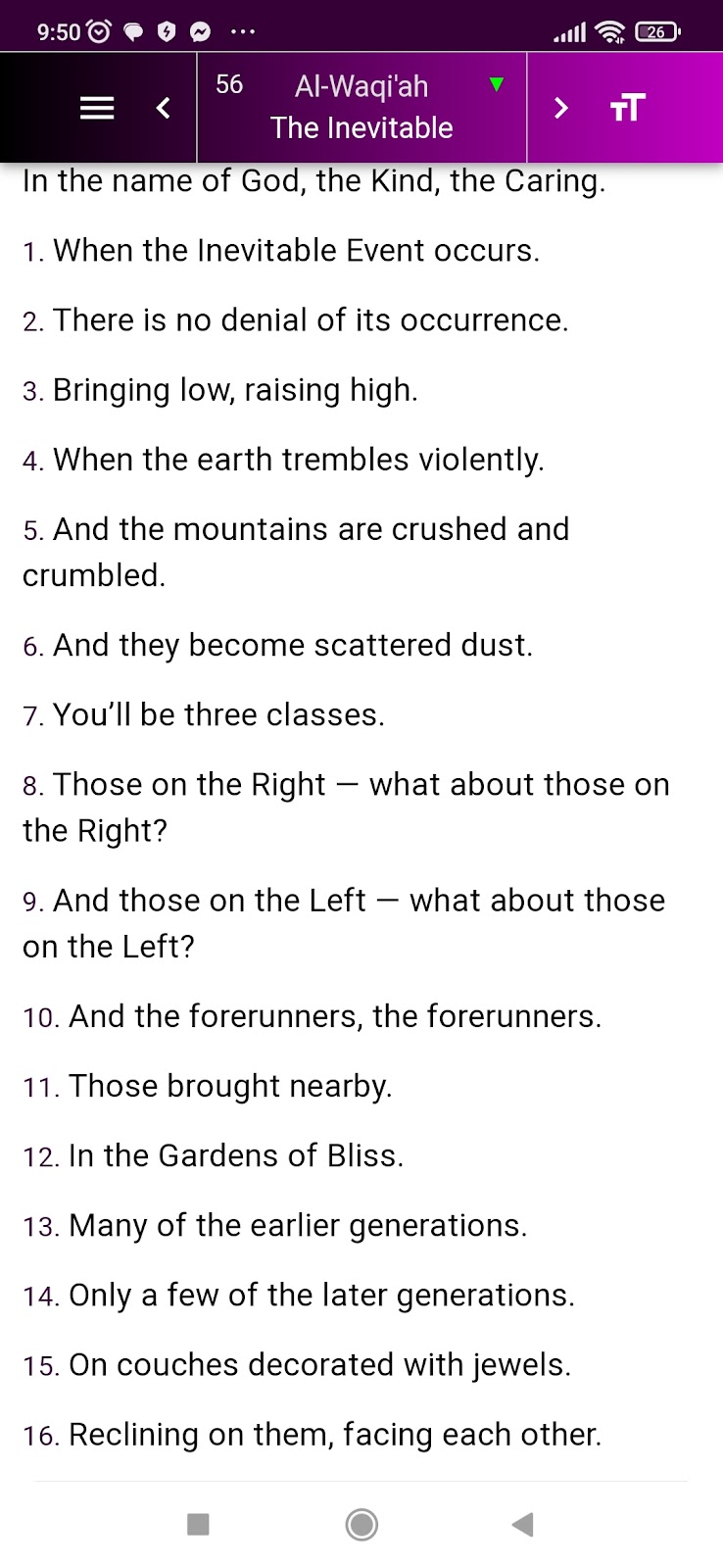
The Day of Judgement description in Holy Quran


Several surahs in the Quran touch upon the scenario and events of the Day of Judgment. Here are some of the surahs that specifically address or mention the Day of Judgment:

Surah Al-Qiyamah (The Resurrection, Chapter 75):
This surah provides a detailed description of the Day of Judgment, including the resurrection of the dead, the accountability of deeds, and the ultimate judgment and recompense.


Surah Al-Haqqah (The Inevitable Reality, Chapter 69)
This surah describes the certainty and inevitability of the Day of Judgment, emphasizing that it will come to pass and that people will be held accountable for their actions.


Surah Al-Infitar (The Cleaving, Chapter 82):
This surah speaks about the disintegration of the heavens and the earth on the Day of Judgment, highlighting the magnitude and cataclysmic nature of the events.


Surah Al-Ma'arij (The Ascending Stairways, Chapter 70):
This surah mentions the scenes and events of the Day of Judgment, including the questioning of individuals and the separation between the righteous and the wicked.


Surah Al-Waqi'ah (The Event, Chapter 56):
This surah depicts the various groups of people on the Day of Judgment and their different fates, emphasizing the distinction between the blessed and the condemned.


Surah Al-Hajj (The Pilgrimage, Chapter 22):
While not exclusively focused on the Day of Judgment, this surah mentions the resurrection and the gathering of all creatures on that day.


Surah An-Nazi'at (Those Who Drag Forth, Chapter 79)
This surah describes the scenes and events of the Day of Judgment, including the resurrection, the gathering of all beings, and the final judgment.


These are just a few examples of the surahs in the Quran that discuss the Day of Judgment. 
The concept of the Day of Judgment is a recurring theme throughout the Quran, and various verses and passages in other surahs also touch upon its events and consequences

Thursday, June 25, 2020

Parents advice to kids


Among the parents obligations toward their children, the fact that they have to show them the right path, the way to piety, common sense and wisdom, in order to have a good life and yearn the divine protection and mercy.

That is an order from Allah almighty to respect:

Soura 31 Lukman

13. When Luqman said to his son, as he advised him, “O my son, do not associate anything with God, for idolatry is a terrible wrong.”

14. We have entrusted the human being with the care of his parents. His mother carried him through hardship upon hardship, weaning him in two years. So give thanks to Me, and to your parents. To Me is the destination.

15. But if they strive to have you associate with Me something of which you have no knowledge, do not obey them. But keep them company in this life, in kindness, and follow the path of him who turns to Me. Then to Me is your return; and I will inform you of what you used to do.

16. “O my son, even if it were the weight of a mustard-seed, in a rock, or in the heavens, or on earth, God will bring it to light. God is Kind and Expert.

17. O my son, observe the prayer, advocate righteousness, forbid evil, and be patient over what has befallen you. These are of the most honorable traits.

18. And do not treat people with arrogance, nor walk proudly on earth. God does not love the arrogant showoffs.

19. And moderate your stride, and lower your voice. The most repulsive of voices is the donkey’s voice.”

20. Do you not see how God placed at your service everything in the heavens and the earth? How He showered you

Through Holly Quran, Allah Exalted commands us to preserve them from punishment in verse 6 of sura 66:


6. O you who believe! Protect yourselves and your families from a Fire, whose fuel is people and stones. Over it are angels, fierce and powerful. They never disobey God in anything He commands them, and they carry out whatever they are commanded.
In another context in the Holly Quran, Noah asked his son to repent and be among the faithful;
alas, the latter persisted in disbelief and therefore ended up with those who incurred the
wrath of God and perdition.

Sura 11- HUD

42. And so it sailed with them amidst waves like hills. And Noah called to his son, who had kept away, “O my son! Embark with us, and do not be with the disbelievers.”

43. He said, “I will take refuge on a mountain—it will protect me from the water.” He said, “There is no protection from God’s decree today, except for him on whom He has mercy.” And the waves surged between them, and he was among the drowned.

44. And it was said, “O earth, swallow your waters,” and “O heaven, clear up.” And the waters receded, and the event was concluded, and it settled on Judi, and it was proclaimed: “Away with the wicked people.”

45. And Noah called to his Lord. He said, “O My Lord, my son is of my family, and Your promise is true, and You are the Wisest of the wise.”

46. He said, “O Noah, he is not of your family. It is an unrighteous deed. So do not ask Me about something you know nothing about. I admonish you, lest you be one of the ignorant.”